
Brass Jewelry Production: Polishing Before Plating
Polishing is the last point in a brass order where a surface can still be changed without undoing work. The published eight-step flow places high-gloss polishing at step four and surface art at step five, both ahead of electroplating at step six, which means half of the sequence after casting is surface work. At a 100-piece MOQ per design, that half is worth auditing.
Key takeaways
- Four of the eight published steps — sprue cutting, polishing, surface art and plating — happen after the casting is poured.
- High-gloss polish and brushed or textured surface art are separate steps, and both precede electroplating.
- Brass MOQ is 100 pieces per design; 100% final inspection covers every piece, not a sample.
- CAD is quoted under 48 hours, which is 2 days inside a 25–30 day sampling block.
Polishing is the last chance to correct a casting
A casting arrives with a gate, a sprue and a surface that reflects the mould rather than the design. Sprue cutting takes the gate off. Polishing then works through the cut mark, the parting line and any tool chatter until the surface reads as intentional. After that point, the piece is either coated or scrapped, and coating does not remove anything.
The distinction that matters on the bench is between a defect that sits on the surface and one that sits inside it. A cut mark is on the surface; polishing removes it. A gas pit or a cold shut is inside the metal; polishing opens it into a wider crater rather than closing it. That is why a pre-plating inspection is more useful than a post-plating one: the faults that plating cannot cover are all visible before the bath.
A buyer does not need to identify the metallurgy to use this. A simple light test — rotate the piece under a single bench lamp and watch for a line that moves with the light — separates a surface scratch from a pit. A scratch travels across the curve; a pit stays in one place and darkens at its centre.
Gloss, brushed and textured are three specifications
High-gloss polishing is a directional process. Each pass leaves fine lines, and the next finer compound removes them, so the finish is a function of how many grades the shop runs and how much time each piece receives. A gloss that stops one grade early looks acceptable on a flat sample and reads cloudy on a curved ring.
Surface art comes after the gloss, and it is where the design decides what the piece should look like rather than how clean it is. Brushed finishes cut deliberate parallel lines; textured finishes raise a pattern that scatters light. Both are applied to bare metal, then plated. Applied after plating, they would cut through the coating and expose the alloy at every groove.
Direction is the part of a brushed finish that is hardest to describe and easiest to see. Lines that run around a cuff read as a continuous band; lines that stop at the edge of a curve read as a mistake. A drawing should show the direction on the flat view, and the master should show it on the formed piece, because the two views are not the same instruction.
That is the practical reason the published order cannot be reversed. Texture applied after plating is a repair, not a finish, and it produces a piece with coating in the recesses and bare brass on the high points — the reverse of what a wear test would want.
A pre-plating inspection sheet
An inspection sheet for the surface stage is short. It lists what should be visible at each step, what should not be, and who signs when the piece moves on. The table below follows the published flow from sprue cutting to packing.
| Stage | Surface condition | What it reveals |
|---|---|---|
| Sprue cutting | Gate removed, cut mark visible | Whether the gate was cleanly separated |
| High-gloss polishing | Mirror direction, no tool chatter | Scratches and residual parting lines |
| Brushed finish | Parallel lines, even spacing | Inconsistent hand pressure or worn abrasive |
| Textured finish | Pattern depth repeated across pieces | Whether the pattern is design or accident |
| Electroplating | Even colour, no thin edges | Coverage on high points and inside curves |
| Final QC | Every piece handled | Mismatches a customer would find first |
The fourth row is the one buyers forget. A textured finish is only repeatable if the tool that made it is controlled, and a pattern that varies between pieces in the same lot is a specification failure rather than a charming inconsistency.
What a rework loop does to the calendar
Rework is not a single extra operation. A piece rejected after plating has to be stripped, re-polished, re-textured where relevant and re-plated. Each of those is a stage that already had a slot in the schedule, and the second pass competes with new work for the same bench time.
This is the argument for spending review effort on the master rather than on the bulk run. A master that shows the final surface at full size settles the gloss level, the brushing direction and the texture depth before 100 pieces are committed. A custom brass jewelry OEM that treats polishing as a cosmetic afterthought will discover the surface problem in the bath, when the correction has already left the schedule.
Ask for the approved master to be kept as a physical reference, not a photograph. Photographs lose the directional highlight that distinguishes a good gloss from an acceptable one, and a reference that cannot be matched under a lamp is not a reference.
Worked example
Count the published steps that touch the surface. Of the eight, sprue cutting, polishing, surface art and electroplating are four, so 4/8 = 50% of the sequence happens after the casting is poured. Three of those four — cutting, gloss, texture — are done with the metal bare.
Sampling dominates the calendar: 25–30 days against 21–28 days of bulk and 2 days of CAD. Those blocks only overlap where the brief allows it, so the window a buyer books runs from 48 days (2 + 25 + 21) to 60 days (2 + 30 + 28). Divided by seven, that is 6.9 to 8.6 weeks — and the surface work sits inside the bulk block, not beside it.
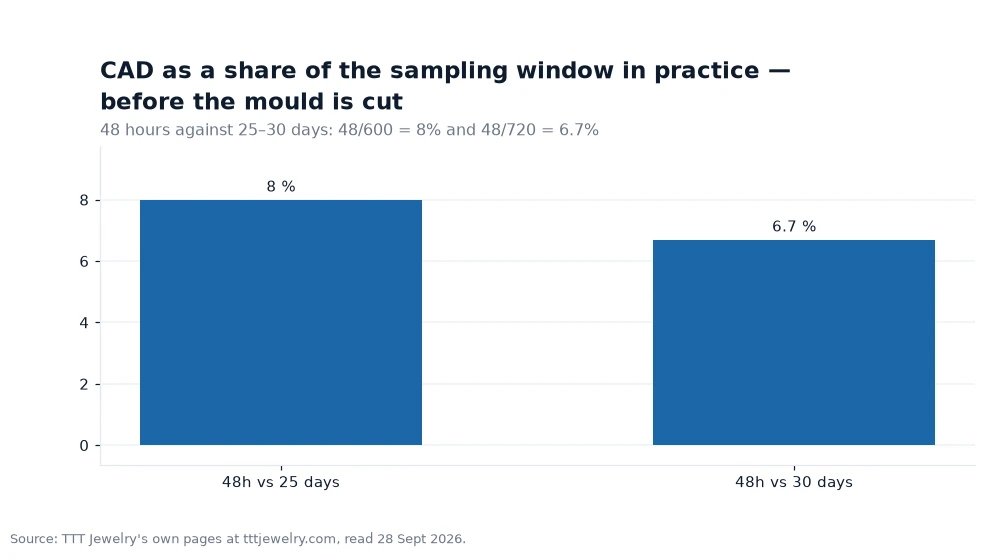
The design step is small inside that. At 48 hours against 25 days, CAD is 2/25 = 8% of the sampling window; against 30 days it is 2/30 = 6.7%. Since the surface is settled in the master, that 8% or 6.7% is the stretch of the schedule to extend by a day of review, because a day there costs less than a rework loop later.
Frequently asked questions
How many polishing stages does a brass order go through?
The published flow runs a high-gloss polishing step at stage four, then a separate surface-art step for brushed or textured effects, both before electroplating.
Can polishing fix a casting defect?
It removes sprue marks and tool lines but cannot fill porosity, so a pit opened by polishing stays visible once the coating goes on.
Should brushing run before or after plating?
Before: the published sequence applies surface art at stage five and electroplating at stage six, so texture is set in the bare metal and then coated.
Writing the surface clause
Write the surface clause before the master is cut: gloss level on a scale both sides can see, brushing direction, texture depth, and the light under which approval happens. Where a range mixes metals, keep one clause per process, since brass takes a plated finish and stainless takes PVD. A buyer running both alongside a custom jewelry wholesale replenishment programme will need two clauses rather than one, and the TTT Jewelry process pages set out the eight steps behind both routes. Then check the evidence at the end of the first run: hold three pieces from the lot beside the master, under the same lamp, and look for the highlight; if it matches on all three, the next order starts from a physical reference rather than from memory.
Source note: figures come from the manufacturer's own website (tttjewelry.com), read 28 Sept 2026.[1]