
Fragrance Manufacturing Case Studies: What Suppliers Show Now
A fragrance manufacturer's case study used to be a photograph, a scent name and a sentence about partnership; today it is more likely to include a brief, a constraint, a timeline and an outcome. That shift is genuinely useful for buyers, because a case study that names the constraint can be checked, and one that names only the result cannot. But the change has also produced a new kind of theatre, where compliance language and process diagrams surround a project that was never difficult. Knowing which parts of a modern case study carry evidence is now a due diligence skill in itself.
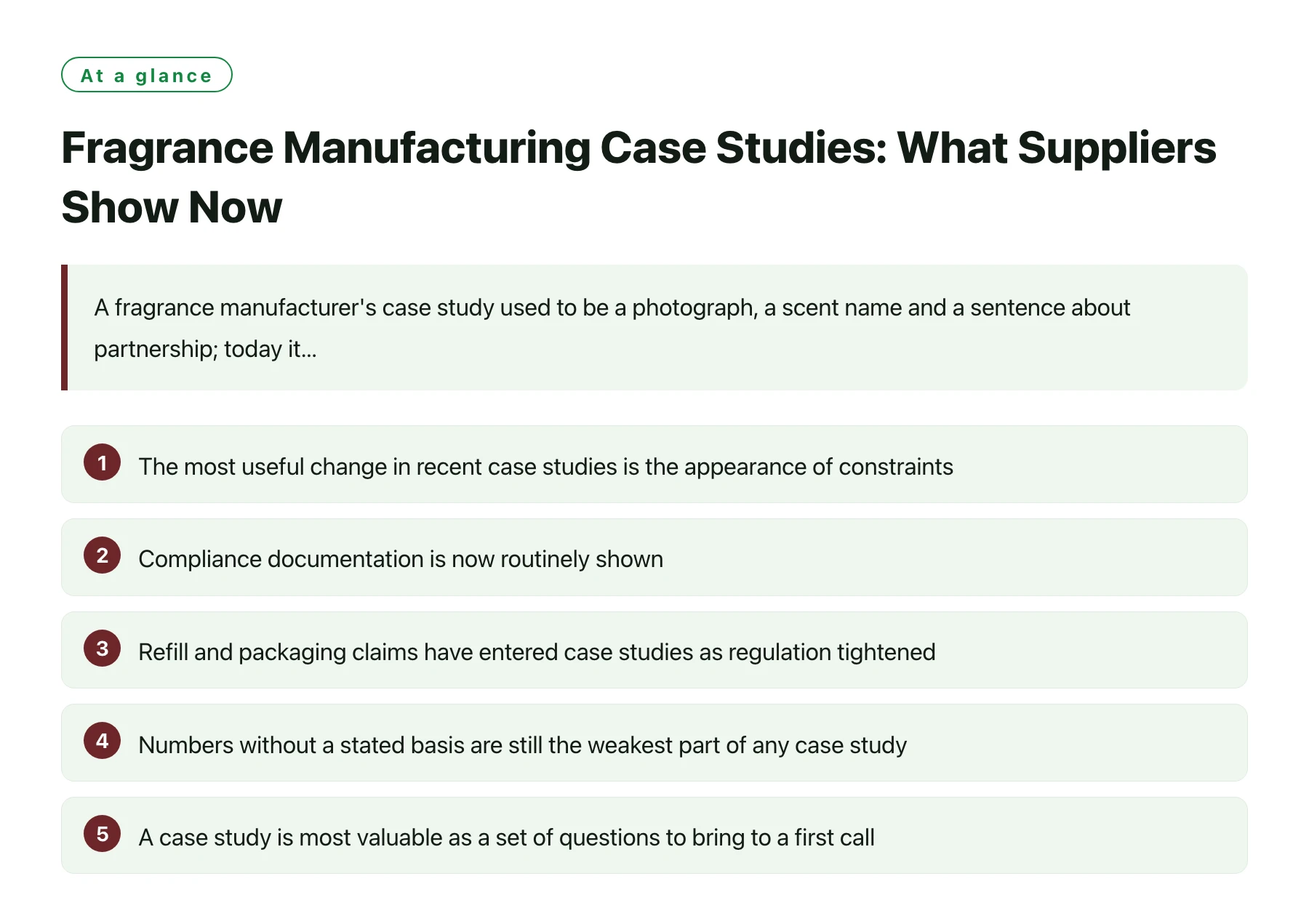
Key takeaways
- The most useful change in recent case studies is the appearance of constraints, because a named constraint is the only part a buyer can verify against their own project.
- Compliance documentation is now routinely shown, but its presence proves a process exists rather than proving it was applied well.
- Refill and packaging claims have entered case studies as regulation tightened, and they should be read as design intent until a material and a take-back route are named.
- Numbers without a stated basis are still the weakest part of any case study, whether they describe volume, speed or reduction.
- A case study is most valuable as a set of questions to bring to a first call, not as a substitute for one.
Five years ago, a supplier case study was mostly a look book. A bottle photographed against a coloured background, a scent family, a line about collaborating closely with the brand. It told a buyer what the supplier had touched and nothing about how it had behaved when the project became difficult.
The format has changed because buyers changed. Retail own-brand programmes expanded, and with them a demand for evidence rather than aesthetics: specifications, compliance paperwork, testing summaries, timelines. Manufacturers responded by showing process, and the case study moved closer to an engineering document. That is an improvement, and it also raised the bar for reading one.
Two pressures sit behind the change. The first is regulatory, since cosmetics and fragrance products carry documentation obligations that a supplier now has to be able to demonstrate rather than describe [1]. The second is commercial: own-brand ranges have become a competitive battleground for retailers, and the manufacturing story behind a product has become part of how the product is sold [2]. The result is material that is more informative and more deliberately framed at the same time.
What changed, and what it means for a buyer
| Element | What case studies showed earlier | What they show now, and what it does not prove |
|---|---|---|
| The project | A bottle, a name, a scent family | A brief, a format and a target price; proves the supplier can describe a project, not that it managed one |
| The constraint | Rarely mentioned | A tight window, an unusual base, a difficult pack; the most checkable part of the document |
| The process | A sentence about working together | Diagrams, gate lists and testing steps; proves a method exists, not that it was followed |
| Compliance | Certificates mentioned in passing | Named documentation scoped to a market; proves paperwork, not product performance |
| Packaging | Decoration and finishing as craft | Refill options and material choices discussed as design problems [3] |
| The outcome | A launch photograph | A stated result, sometimes with a number; worth reading only if the basis of the number is given |
| The reference | A client logo, where permitted | Anonymous descriptions of scale and channel; still no substitute for a reference conversation |
The pattern in the third column is the one to internalise: modern case studies are better at showing the shape of a project and no better at proving that the project went well. A buyer who wants the second kind of evidence has to ask for it, and the asking is easier when the case study has already named the constraint.
Why the constraint is the part worth reading
A case study that says a range launched on time is not saying much, because most ranges launch on time. One that says a range launched on time with a custom coated bottle, a twelve-week window and a target price below a stated level is saying something specific, and a buyer can compare that with their own situation. Constraints are what turn a story into a benchmark, and it is the same test worth applying to a one-stop fragrance manufacturing scope page: the list of services matters less than the one project constraint the supplier chooses to mention.
They are also the part most likely to be true. It is difficult to invent a plausible constraint and reference it consistently across a document; it is easy to add a process diagram. When reading, look for the sentence that describes what was hard, and note whether the rest of the document explains how it was resolved. If nothing in the case study attaches to that sentence, the constraint was decoration.
Numbers, and how to treat them
Manufacturing marketing has learned to use numbers, and numbers are the easiest element to over-read. A reduction in development time, an increase in capacity, a percentage of something — none of it is meaningful without a stated starting point and a stated method. The industry press has covered the shift toward more quantified claims in personal care and household manufacturing, and the coverage is a useful reminder that a figure in a brochure is a marketing artefact until its basis is explained [4].
The practical rule is to accept a number as a question rather than as an answer. Ask what the baseline was, over what period, and who measured it. A supplier with a real result will have those answers ready because it had to produce them internally. A supplier without them will retreat to adjectives, which is informative in itself.
Turning a case study into a shortlist
The most productive use of a case study is to generate questions and then to compare how different suppliers answer the same ones. Pick two projects from a portfolio, ideally ones in your own channel and format, and write down four questions: what the constraint was, who held the development thread, which tests were run and by whom, and what the buyer received at the end.
Take those questions to a first call and listen for specificity. A manufacturer that can walk through a comparable project in detail is demonstrating something a portfolio page cannot, and it is the same reason publishers of private label fragrance production material tend to lead with process rather than with photography. Buyers who want a structured way to run that first conversation can use due diligence on a perfume manufacturer as a checklist rather than inventing one. Reading a portfolio such as Xuelei with those four questions in hand takes twenty minutes and produces a page of notes that will carry the first meeting.
If only one habit comes from this, make it naming the constraint out loud in the first meeting and asking the supplier to describe a project where it applied. Every serious manufacturer has one; the answer reveals whether the constraint was understood or merely survived. Case studies are useful for choosing who to call and not for deciding who to sign, which is why the documents matter more than the portfolio, and why a supplier that can show its background and certifications alongside a specific project story is easier to assess than one with a longer gallery.
Sources
- European Commission: Cosmetics in the EU —— The European Commission's overview of EU cosmetics rules, including the responsible person, product information file and safety report requirements.
- Cosmetics Business —— A trade publication covering the beauty and cosmetics industry, including fragrance launches and regulatory developments.
- Sustainable Packaging Coalition —— A membership organisation working on more sustainable packaging design, publishing material and recyclability guidance.
- HAPPI — Household & Personal Products Industry —— An industry magazine covering the household and personal care market, including fragrance, formulation and packaging.
Frequently asked questions
Are manufacturer case studies ever verified?
Rarely in a formal sense. Some are reviewed by the client before publication, especially where a logo or a name is used, and those tend to be more accurate about constraints. Most are written by the supplier's own marketing team. The practical approach is to treat the named constraint as the checkable part and to verify it in conversation.
What should a brand ask for instead of a case study?
A reference conversation, or a walkthrough of a comparable project including its problems. A supplier that can describe a project that went wrong, and what it did next, is usually a more reliable partner than one whose portfolio contains only successes, because development work rarely runs perfectly.
Do compliance documents in a case study prove anything?
They prove that a documentation process exists and that the supplier knows which certificates and reports its markets expect. They do not prove that a specific batch was tested or that a process was followed on your project. That is established by the documentation delivered with your own order.
Why do refillable and packaging claims appear in more case studies now?
Because packaging rules and retailer expectations have moved, and designs that were optional a few years ago are now part of the brief for many ranges. A claim is only meaningful when it names the material, the refill mechanism and what happens to the pack at end of life, so those are the details to look for.
How many case studies should a brand read before shortlisting?
Enough to see whether the supplier works in your formats and channel, which is usually a handful rather than a whole portfolio. Depth on two comparable projects is worth more than a scan of twenty, because the questions you generate from the detailed reading are what make the first call productive.